

Facing the Qibla — An Unbroken Obligation
Before every prayer — before the intention, before the first words, before everything — a Muslim must face the Qibla. The Qibla is the direction of the Kaaba in Makkah: the sacred house of Allah, the point toward which 1.8 billion Muslims around the world orient themselves in prayer. Five times each day. Every day.
"So turn your face toward the Sacred Mosque. And wherever you are, turn your faces toward it."— Surah Al-Baqarah (2:144)
The instruction is universal and unconditional. Wherever you are, face it. Whether you are at home, in an office building, in an airport, in a country you have never visited before — you turn toward Makkah.
"When you stand to pray, perform your ablution perfectly, then face the Qibla and say Allahu Akbar."— Sahih al-Bukhari & Sahih Muslim
The Prophet Muhammad SAW instruction is clear and sequential: facing the Qibla comes before the prayer begins. It is not part of the prayer — it is the condition that makes the prayer valid. Scholars across all major schools of Islamic jurisprudence agree: prayer performed without facing the Qibla, when one was able to determine it, is not valid.
Why Finding the Qibla Has Always Been a Challenge
For much of Islamic history, determining the Qibla required real knowledge. Scholars memorised Qibla bearings for major cities. Islamic astronomers and mathematicians later developed specialised methods of Qibla calculation (ʿilm al-qibla), allowing direction to be determined with remarkable precision centuries before modern navigation technology. Mosques were built facing Makkah based on careful celestial observation, while physical compasses and published direction tables helped travellers and communities maintain accuracy.
But Muslims have always travelled, relocated, and found themselves in unfamiliar places. A traveller arriving in a new hotel room. A student in a university library. A professional in a foreign office building. A pilgrim in transit at an international airport.
In all of these situations, the question is the same: which way is Makkah? And for much of Islamic history, the answer often required asking someone, consulting a reference, or making an educated guess based on geography.
Even today — with smartphones in every pocket — not all Qibla tools calculate direction correctly. Some apps use simplified flat-map approximations that introduce meaningful errors at higher latitudes, in countries like the United Kingdom, Canada, Scandinavia, or northern Asia, where the true great-circle bearing to Makkah differs significantly from a straight flat-map line.
The result: Muslims who believe they are praying in the right direction — but who are not. A small error in Qibla bearing is not trivial when it affects the validity of every Salah prayed in that location.
GPS Precision. Geodetic Accuracy. Real-Time Response.
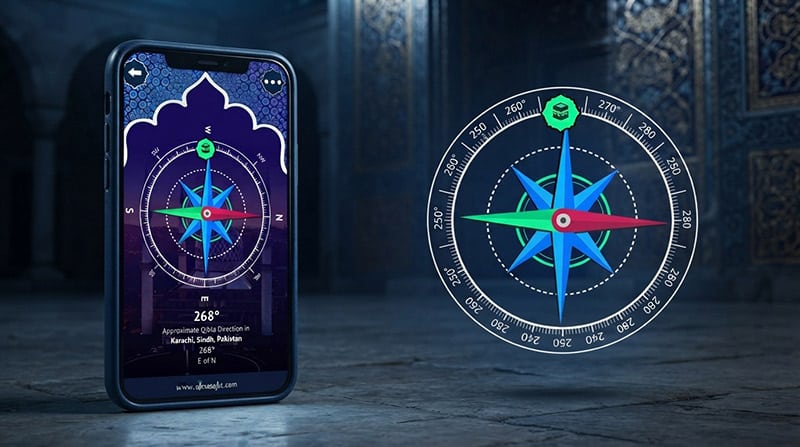
allMasajid calculates the Qibla direction using two device sensors working simultaneously: your GPS for location, and your device compass for orientation. The result is a live, dynamic arrow that always points toward Makkah — updating in real time as you rotate your device.
Crucially, allMasajid uses great-circle calculation — the geodetically correct method. It treats the earth as the sphere it actually is, and computes the shortest path across its surface from your exact coordinates to the Kaaba (21.4225°N, 39.8262°E). This is the true Qibla bearing — not an approximation, and not a regional average.
When the arrow on your screen points directly upward, you are facing Makkah. The precise degree bearing is displayed numerically at all times, alongside cardinal direction markers. There is no guesswork. Just direction.
A Muslim checking prayer times on allMasajid while travelling, precise times calculated for their current GPS location.
What the Qibla Direction Feature Does — In Detail
GPS + Digital Compass Working Together
The Qibla feature uses your device's GPS (CoreLocation on iOS, standard location services on Android) to establish your precise geographic coordinates. Your device's digital compass (CoreMotion on iOS, magnetometer on Android) reads your current orientation in real time — updated continuously as you move and rotate.
Together, these two data points produce a dynamic Qibla indicator that always points toward Makkah without any manual input from you.
Great-Circle vs Flat-Map — Why It Matters
Not all Qibla apps calculate direction the same way. Some use a simplified flat-map approximation that works reasonably well near the equator but produces meaningfully incorrect results at higher latitudes.
For a Muslim in London, the flat-map Qibla bearing points roughly southeast. The great-circle bearing — the correct one — actually points southeast but with a notably different inclination due to the curvature of the earth. The difference can be significant at higher latitudes, making accurate great-circle calculations important for reliable Qibla direction.
allMasajid uses the geodetically correct method. Every time. At every latitude. For every user.
Qibla Direction in Real Muslim Life
The Qibla feature was built with the same question that guides every part of allMasajid: what does a Muslim actually need, in the real conditions of their day?
Checking Into a Hotel Room
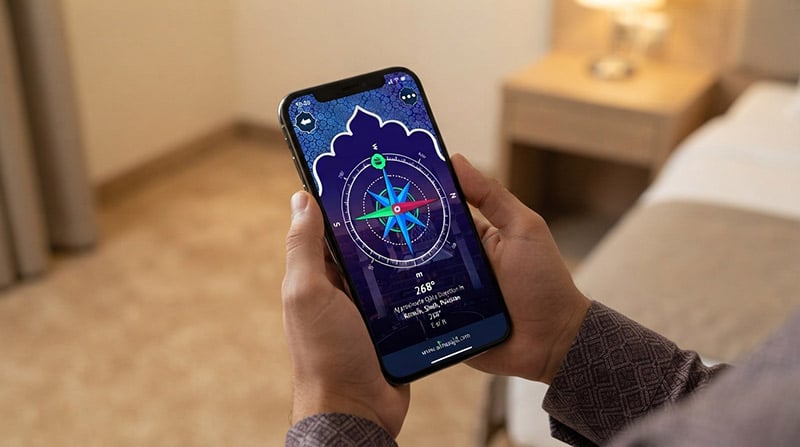
You have arrived in a new city and your hotel room could face any direction. You open allMasajid, hold your phone flat, and within seconds the compass arrow orients toward Makkah. You know which wall to face before unpacking.
Praying in a Corporate Office
You have found a quiet room for Dhuhr but have no idea which direction is Makkah. The building has no mosque indicator and no one to ask. allMasajid gives you the bearing instantly using your device's location and compass, helping you identify the correct direction with confidence.
Checking Into a Hotel Room
You have arrived in a new city and your hotel room could face any direction. You open allMasajid, hold your phone flat, and within seconds the compass arrow orients toward Makkah. You know which wall to face before unpacking.
Airport Prayer Rooms & Transit Stops
You have a short layover between flights and need to pray in an unfamiliar terminal. Rather than searching for signs or asking for directions, allMasajid helps you identify the Qibla quickly so you can focus on your prayer before boarding.
New Country, No Local Knowledge
You have relocated abroad and are unfamiliar with the local geography. Rather than relying on guesswork or asking locals, you open allMasajid and get the precise great-circle bearing for your exact coordinates.
Student Prayer Room
You find an empty study room to pray in. The room has no Qibla marker. You spend less than 10 seconds with allMasajid and are ready to pray — with confidence in the direction.
How to Access Qibla Direction in allMasajid
The Qibla Direction feature is available to all users — no account required. Accessing it takes less than 30 seconds from opening the app.
- Open allMasajid on your iPhone or Android device.
- From the Home Screen, tap the Qibla Direction icon in the navigation menu.
- Allow location access if prompted — this is required for GPS-based calculation.
- Hold your phone flat on a level surface, away from metal objects or large electronics.
- Slowly rotate your body until the compass arrow points directly upward on the screen.
- The degree bearing displayed confirms your exact Qibla direction.
- If prompted to calibrate: move your phone in a slow figure-eight motion for a few seconds, then retry.
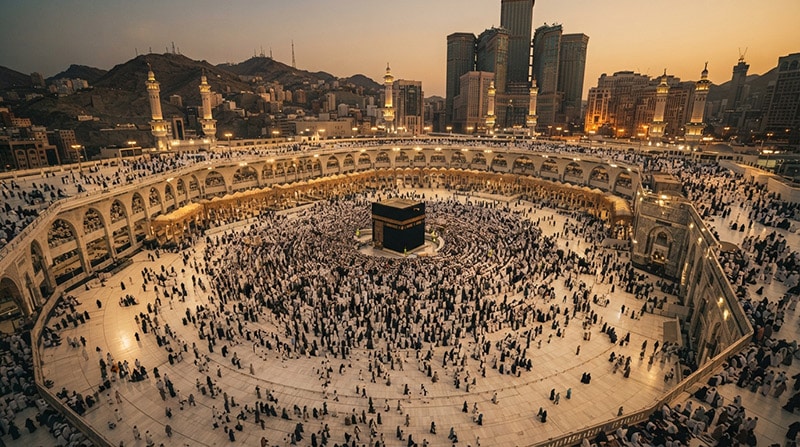
Finding the Qibla is often the first step before prayer. Once you're oriented toward Makkah, allMasajid provides additional tools to help you prepare, pray, and stay connected throughout your daily worship journey.
While You Have allMasajid Open — Explore These Too
After finding the Qibla, allMasajid keeps you connected to your full Islamic journey:
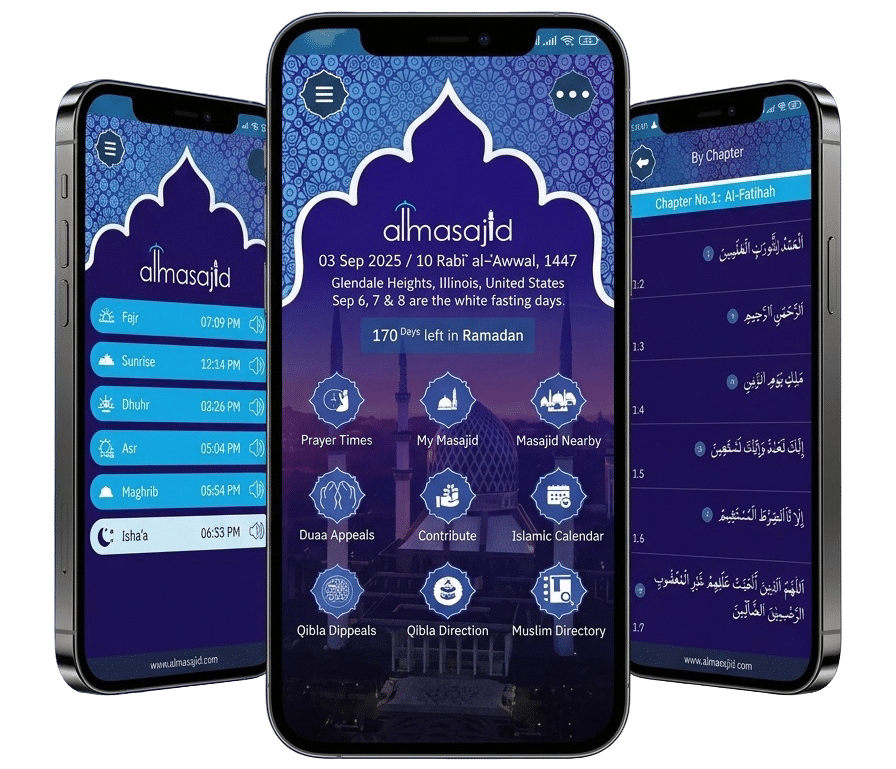
- 1Check today's prayer times — GPS-accurate Fajr, Dhuhr, Asr, Maghrib, and Isha
- 2Locate nearby masajid — find mosques close to you with one-tap directions
- 3Read the Quran — all 114 Surahs with Arabic text and English translation
- 4Access Islamic calendar events — Ramadan, Eid, Muharram, and every sacred date
- 5Learn about Islamic occasions — seasonal guides and articles in the resource centre