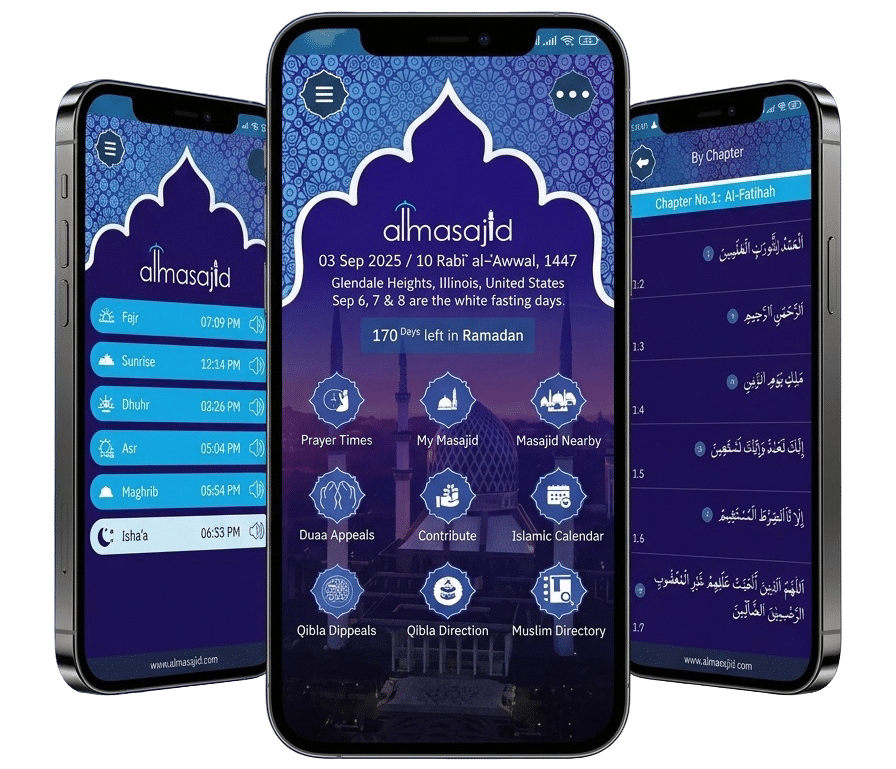


Prayer Times in allMasajid
GPS-Accurate. Fully Personalised. Always With You.
How allMasajid calculates precise prayer times for your exact location, and why the details behind that accuracy matter for every Muslim's daily worship.
The Obligation of Salah, and the Role of Time
Five times a day, Muslims around the world stop whatever they are doing and turn toward Allah. This is not a habit or a cultural practice. It is one of the five pillars of Islam, a divine command that structures the entire rhythm of a Muslim's life.
But Salah is not simply about praying. It is about praying at the right time. The Quran itself ties prayer directly to the movement of the sun, not to a clock, not to a schedule, but to the sky itself.
"Establish prayer at the decline of the sun until the darkness of the night and [also] the Quran of dawn. Indeed, the recitation of dawn is ever witnessed."Surah Al-Isra (17:78)
Fajr begins as true dawn breaks across the horizon. Dhuhr starts the moment the sun crosses its zenith. Asr is anchored to the length of shadows. Maghrib follows immediately after sunset. Isha comes when the sky has darkened completely.
These are not arbitrary time slots. They are anchored to celestial movement, and they shift every single day, across every latitude, in every season. A Muslim in Reykjavik and a Muslim in Karachi pray the same five prayers, but never at the same hour.
"The best deed is to pray at its earliest time."Sahih al-Bukhari
The Prophet Muhammad SAW linked the virtue of Salah not just to its performance, but to its timing. Praying at the first available moment is described as the best of deeds. Every minute matters.
Why Getting Prayer Times Right Is Not Simple
For most of Islamic history, prayer times were called by a Mu'adhdhin, the person who calls the adhan, who observed the sky directly. The adhan was the mechanism. The human eye was the instrument. Communities lived and prayed together in alignment.
Modern Muslim life disrupted that entirely. Muslims today live in dozens of time zones. They travel across continents in a single day. They work in offices without windows, commute underground, and live in cities where the call to prayer is not broadcast. Many, especially those living as minorities in non-Muslim countries, have no external reminder that a prayer time has arrived at all.
To make things harder: prayer times cannot simply be memorised. They shift every single day. The difference between Fajr in January and Fajr in June at northern latitudes can be more than two hours. Asr in winter ends before the working day is over; in summer it falls mid-afternoon. Isha at high latitudes in summer may not arrive until very late at night.
Without an accurate, location-specific, automatically-updating source of prayer times, many Muslims simply miss prayers. Not from negligence. From the practical difficulty of tracking them without help.
Precise, Personalised, Automatic, Every Single Day
allMasajid calculates prayer times using your device's live location, delivering a schedule tailored to your exact coordinates rather than a city-wide average. Whether you are at home, travelling, or in a location you have never visited before, your prayer times are calculated specifically for where you are.
Your device time zone is detected automatically. When you cross into a new time zone while travelling, your prayer times update without any input from you. The app adapts to your life, not the other way around.
allMasajid then presents those times with a live countdown to your next prayer, turning a static schedule into something you can feel the urgency of. It is not just information. It is a gentle, constant reminder that the next moment of standing before Allah is approaching.
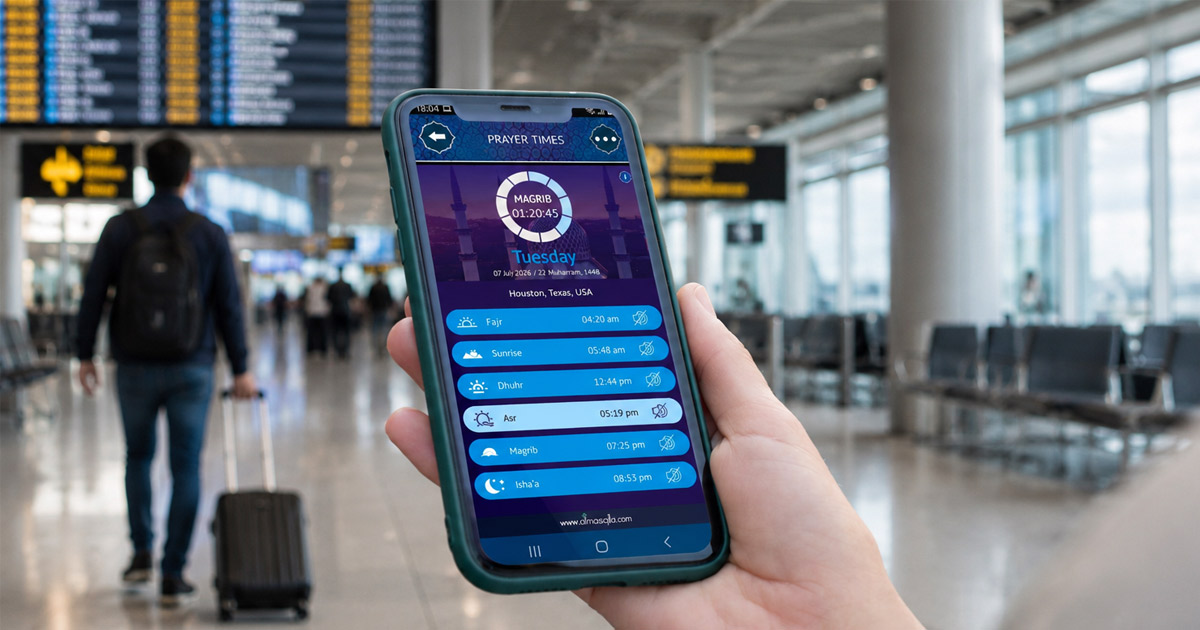
A Muslim checking prayer times on allMasajid while travelling, precise times calculated for their current GPS location.
What the Prayer Times Feature Does, In Detail
GPS-Based Location Detection
allMasajid reads your GPS coordinates through your device's location services, your exact latitude and longitude, calculated in real time. No manual city selection is required. Your city and country are displayed on screen so you always know which location is being used.
Multiple Islamic Calculation Methods
Different scholarly bodies around the world use different formulas for determining the start and end of twilight, which directly affects Fajr and Isha times. allMasajid supports all major calculation methods:
- Islamic Society of North America (ISNA)
- Muslim World League (MWL)
- Egyptian General Authority of Survey
- Umm al-Qura University, Makkah
- University of Islamic Sciences, Karachi
- Gulf Region Standard
- HCNA (Hilal Committee of North America)
Select your method once in Settings. The app applies it to every prayer time calculation from that point forward.
Hanafi and Shafi'i Asr Calculation
Asr deserves its own mention. There are two scholarly positions on when Asr begins. The Shafi'i school holds that Asr starts when an object's shadow equals its own height. The Hanafi school holds that Asr begins when the shadow is twice the object's height, which makes Asr later in the day.
Asr begins when an object's shadow equals its own height. This results in an earlier Asr time.
Asr begins when an object's shadow is twice its own height. This results in a later Asr time.
The difference between these two positions is meaningful in practice, especially during summer months at higher latitudes, where the gap can be 45 minutes or more. allMasajid allows you to select your juristic school in Settings, and Asr will be calculated according to your tradition.
Live Countdown to the Next Prayer
The Prayer Times screen displays a real-time countdown to the next upcoming prayer, updating every second. When one prayer passes, the countdown immediately switches to the next.
This transforms prayer times from a static list into something dynamic and actionable. The countdown keeps you connected to the rhythm of the day in a way that a simple clock does not. You always know how long you have, and when to begin preparing.
Prayer Times in Real Muslim Life
The Prayer Times feature was not built for ideal conditions. It was built for the reality of how Muslims actually live, and the variety of situations in which Salah must be prayed.
-
The Traveller on a Long-Haul Flight
You board a 10-hour flight and want to know exactly when Dhuhr, Asr, and Maghrib fall during the journey. allMasajid uses your last confirmed GPS coordinates and updates as you land, no setup required.
-
The Professional in a Windowless Office
You have back-to-back meetings and no access to an adhan. The live countdown on allMasajid alerts you that Asr is 15 minutes away, enough time to find a quiet space and prepare.
-
The Muslim in a New Country
You have just arrived in a city you have never visited. You do not know local prayer times or calculation methods. allMasajid reads your GPS coordinates and delivers a precise schedule for your exact location within seconds.
-
The Student on a University Campus
allMasajid keeps your prayer schedule easy to access throughout the day, whether you are moving between buildings, classrooms, or prayer rooms.
-
Ramadan Night Prayers
During Ramadan, Suhoor and Isha timings become critical. allMasajid displays the full daily schedule including a Fajr countdown, so late-night ibadah and early Suhoor are never missed.
How to Access Prayer Times in allMasajid
Getting to your prayer times takes seconds. Here is exactly where to find the feature and how to configure it for your needs.
- 1Open allMasajid on your iPhone or Android device.
- 2Tap the Prayer Times icon on the Home Screen, it is the first feature in the navigation.
- 3Your prayer schedule for today loads automatically based on your GPS location.
- 4The next prayer is highlighted with a live countdown at the top of the screen.
- 5To change your calculation method or Asr school: tap the Settings icon within the Prayer Times screen.
- 6To enable prayer notifications: tap the bell icon beside any prayer and toggle your preferred alert timing.
- 7To share your prayer schedule: tap the Share icon at the top right of the screen.
The Prayer Times feature is available to all users, no account required. Prayer notifications require a free allMasajid account.
While You Have allMasajid Open, Explore These Too
Once your prayer time arrives, allMasajid can also help you:
- Find nearby masajid, locate your nearest mosque with one tap
- Check Qibla direction, face Makkah with GPS accuracy, wherever you are
- Read daily duas, authenticated supplications for every moment of your day
- Access the Quran, all 114 Surahs with Arabic text and English translation
- View Islamic dates, stay aligned with the full Islamic calendar year
Explore all features at allmasajid.com